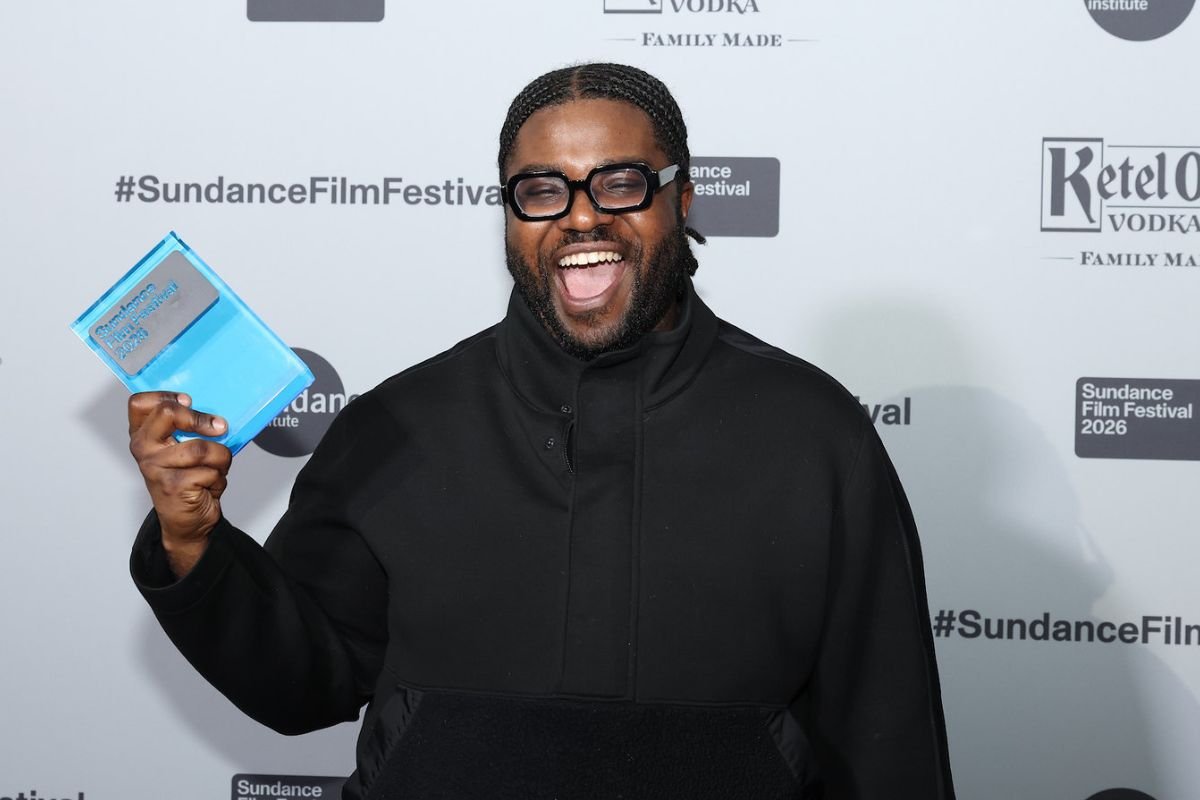
Few weeks after his own American success, Will Niava is speaking about the last couple of filmmakers from the continent to have shown their film and won awards at the world’s biggest independent film festival. Naturally, he seems joyful. Was he aware that, a couple years before, another West African filmmaker had won the same award he took at the prestigious festival? He is and he mentions the name—Akinola Davies Jnr—immediately. “The fact that he won meant that my voice could also be heard around the world,” he says. “You can see the things that it has done for his career and these are the things that I am looking for.”
He then goes on to mention other African filmmakers who have been to Utah for Sundance before the internet temporarily freezes up his image on my screen. He is, obviously, a student of Africa’s success at international venues. Which is a good thing because he is now one of those success stories.
Although based in Canada, Niava is speaking from Accra, where his mother, a Ghanaian, lives and where he was raised from age 12 after his birth, in Abidjan, to two high-profile linguists. He talks about his dad, an Ivorian, translating for Mandela and his mum doing work for the WHO, his respect for both of them about as audible in his voice as his cosmopolitanism. His Sundance-winning short, Jazz Infernal, is dedicated to the memory of his father.
Niava is himself a dad now—a “hands-on parent”, as he calls it—to an 8-month-old baby. Which tells me he’s riding quite the high: Bicoastal living, new baby, Sundance award. It’s a charmed life.
In fact, to get, perhaps, a hint of a setback for the reigning champion of international Sundance short films, you might have to go back—way back.
***
As a kid, he had been a big fan of football and might have gone on to be a professional player but there was one quirk: he was classmates with Jordan Ayew, future captain of the Ghanaian senior football team. As young men, both were students of Lycée Français International Jacques Prévert d’Accra, which he says is Accra’s only school accredited by French authorities. Ayew was so good on the football field that Niava had to reconsider his ambitions.
“His older brother, Andre Ayew, was two classes ahead,” he says. “And after a while, we realised that if there’s anyone who’s going to be a footballer in this school, it’s these two guys. Jordan was always more skilful and Andre had the drive. These guys wake up at 4am to go to the field… I don’t have that level of dedication to football. So, what’s it that I like?”
He had interests in camera and had been in a few plays. But the thing would arrive fully when he was admitted to an American school in Ghana, which his parents chose because they wanted him to go to the US for college. It was in this school that Niava’s dream of filmmaking was kindled; around the same time, he became friendly with someone doing stop motion.
Somehow, his parents changed their minds about the US when it was time, likely because of the spectre of American violence, especially against black men. Why not Canada? His two sisters were already living there. Niava didn’t think this was a great option. For obvious reasons: Which college-aged teenager wants to live with his sister?
An application to NAFTI, Ghana’s main film school, had already fallen through by then because the school felt he didn’t need them. “They said I was doing things they hadn’t been taught.”
Wasn’t this about as flattering as any rejection could be?
Not immediately, he says. A rejection is a rejection. His dad thought otherwise; he had encouraged his kid to do whatever he wanted and that rejection suggested he was on to something. “My parents were one of kind for African parents,” he says.
It was that rejection by NAFTI that spurred two applications to Canadian schools: one in Ottawa and another in Montreal. He chose to apply to just two because he didn’t want “to be rejected by a lot of people”. He had no need to worry. Both said yes, and he chose Montreal partly because he didn’t have a sister in the city. That the city was also French-speaking was appealing to this bilingual kid.
At Montreal, he found their French weird and tried to sign up for the directing class in school but it was filled: “there were only 10 spots”. He got into the documentary class, which he now believes was a blessing. “It taught me how to capture life without a script,” he says, adding that he likes to work with non-actors.
He was there for two years, and when he came out in 2010, he took to directing music videos. There might be other older videos of his lurking on the internet but he says with a laugh that he’d rather they remain anonymous.
***
Not very long after, Niava had an idea that one of his music video projects could be a short film. One reason he had this thought was that he was on set for a short film titled Fauve, which was directed by his pal Jeremy Comte. “I know I can do this too,” he thought to himself. It probably helped his conviction that Fauve received an Oscar nomination in 2019.
So, he wrote a film script his next music video clients loved. The budget was 5000 dollars. Somehow, a friend from LA who was about to start a production outfit read the script and pledged 10,000 dollars. This meant they had 15,000 dollars for the short. “I had never heard this type of money in my life,” he says.
Titled Zoo, this short, which he says was edited in haste, was the first time he was on a set like that one. Naturally, he wasn’t too sure what was happening. Still, he managed to pull it off using “the confidence I had seen on Jeremy’s set to almost fake it.”
Zoo got to the people at Sundance but they weren’t interested. “I remember them bouncing me,” he says. But there was enough in the material for another edit, which Comte suggested. Subsequently, another version was cut and prepared. But the team couldn’t find a distributor. “They said, ‘Your film doesn’t represent our values; it feels a little too Americanised and honestly it’s not a great take on what happens in Quebec.’”
So, the crew decides to figure out how to distribute their film. And then something tragic happened in the US that had rather positive repercussions for Niava and company: the George Floyd video goes viral. “It’s crazy because the way he gets killed is similar to what happened in my film … and without warning, there is this wave of emails.”
Suddenly, this short film that couldn’t find distribution gets invited to scores of festivals, winning awards in the process. “We ended up keeping all the money that we got from the film and didn’t share it with any distributor.”
One of the festivals the film got invited to was Clermont Ferrand, the famous short film festival. There, he met Ghanaian director Anthony Nti, who won the festival’s big prize for Da Yie. “It’s like we were all getting the light at that moment.”
His winning streak continued with a call from Criterion. “It was the most validating thing. I was like wait, ‘This is my first film!’”
He sounds incredulous even now.
***
In February this year, Paradise, a film written by Niava and Comte was screened at the Berlin Film Festival. Set in Ghana and in English, French, and Twi, Paradise got Niava into the sights of Canadian funding bodies, like SODEC, and this came in handy when he was ready with a project of his own.
That project was inspired by a conversation he had with Ange-Eric N’guessan, a Montreal-based musician famous in Ivory Coast but pretty much unknown in Canada. After what sounds like a hilarious exchange, Niava thought they could make a film out of their experiences on their first day in the city they now call home.
A first screenplay didn’t work, its main feedback coming from his Trinidadian-Sri Lankan wife. She told him that since he wasn’t going to therapy or even speaking to her or crying about the loss of his father, maybe he could put all of that pent-up grief in his art. “It hurt my ego but it was coming out of love and care,” he says.
If you have seen the Jazz Infernal, you know that he did exactly what his wife told him. The film is not just dedicated to Niava’s dad, the loss of a father is cleft into the fabric of the narrative. N’guessan plays the lead role as a man who finds himself in Canada and meets two men who recognise his last name and take him to a club where they say his father once played. From that point on, chaotic things happen to our hero.
As you might expect from a former music video director, the film is charged with sound and movement. The technical aspects of the film—the editing, lighting, and cinematography—are flawless. “I wanted it to have my touch, that fast-paced style. I wanted it to feel like free jazz. I wanted it to feel like a Fela Kuti song. That’s the intention I went in with.”
The film’s remarkable editing was carried out by Niava himself and two other persons, one of which is Thomas Bellefleur, an editor who had worked on the 2022 Oscar nominated short film Invincible.
TIFF was the first big festival to accept Jazz Infernal. It opened the festival and Niava seemed to have big hopes that it would win the festival’s main award for its category. It didn’t; the winner was an animation picture that ended up Canada’s submission for the 2026 Oscars. When it got picked for the Oscars, Niava admitted the rival picture was deserving, and over the video call, he appeared to retain the sportsmanship that he probably had all those years ago as a footballer-manque. While, he is competitive, he’s also able to accept a fair loss.
In any case, a win was on the way.
***
Anyone familiar with the workings of the Big 5 film festivals knows that they love a world premiere, which makes it pretty difficult to see that any two festivals on that list accepting the same project. Jazz Infernal became one of the few films to sway programmers at both festivals. “Sundance got over 11,000 submissions, chose 54, and Jazz Infernal was the only one that had previously screened in Toronto,” he says.
When Niava attended screenings at Sundance, he was mesmerised by some of the other projects the festival had selected. He mentions his admiration of Birdie, an impressive short film made by Praise Odigie Paige, a Nigerian-American filmmaker. In fact, as he tells it, he felt Paige’s film was going to be the winner. So, on the night, he decided to just enjoy the festival’s drink and food. So, when the awards were called out, he was far back at the venue in Park City. But then he won as Jazz Infernal received the Short Film Jury Award: International Fiction. Four years before, it was Davies Jnr. It was now his turn.
The win means Jazz Infernal might get a shot at the 2027 Oscars. So perhaps the right culture funding bodies in Canada will consider sponsoring a campaign. In the meantime, Niava says that the success of Davies Jnr’s Lizard and My Father’s Shadow and CJ Obasi’s Mami Wata leads him to believe that the world is ready for stories from Sub-Saharan Africa.
He is now working on a feature film he says will cost a few million dollars to pull off. Asked if that’s a lot, he laughs and says, “There are people who would consider that amount too much and those who would say it’s nothing. I am looking for the second group.”
He is unwilling to say anything specific about the film but he knows it will be ambitious. The man who was born in Ivory Coast, raised in Ghana, and now lives in Canada wants to shoot a film that would involve China and in Ghana. “It’s something that is going to stir a lot of people,” he says. He agrees that such an outline is controversial but adds that controversy is merely a byproduct of his intentions.
“I just want to raise a mirror to ourselves,” he says, “[so we] see what we are doing to our earth and see what we are doing to our people.”