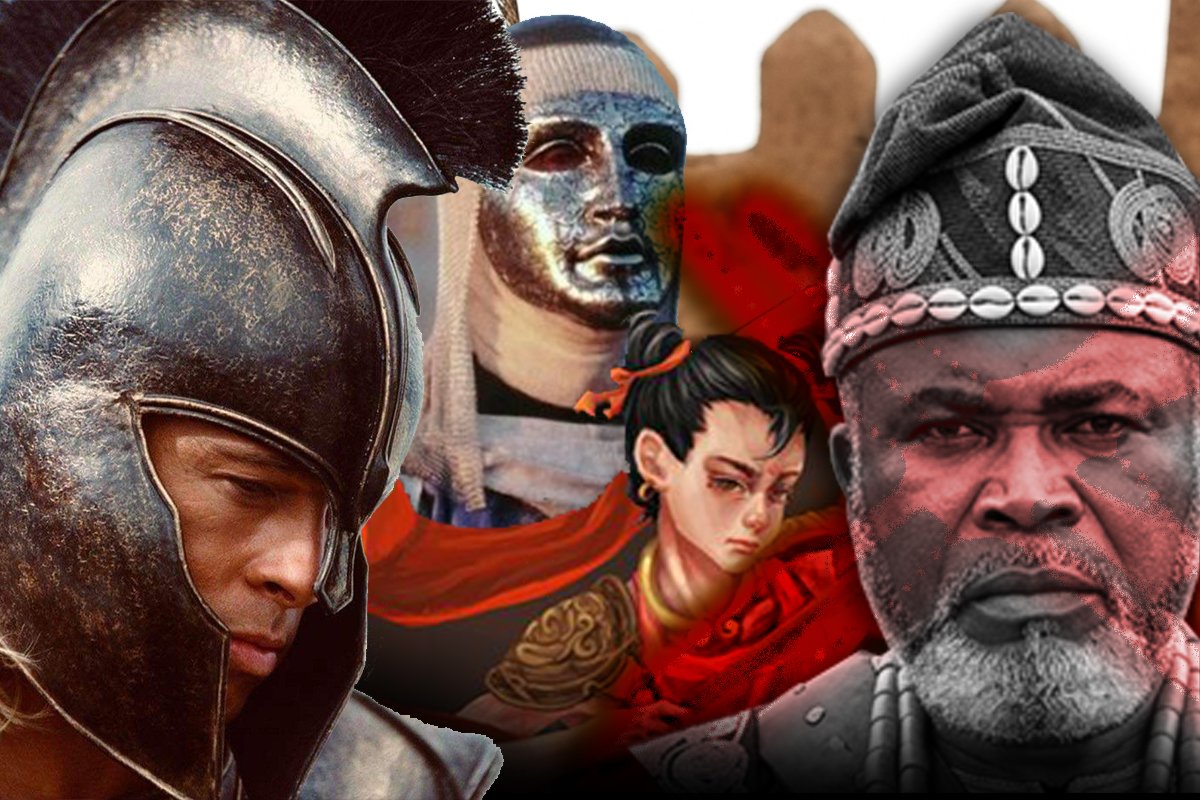
Certain things are just cool. There’s no way to explain why they are cool they just are. In Nollywood, there are only a handful of cool people. This doesn’t diminish everyone else making good stuff that we praise and admire, but cool is its very own class.
Across directors, producers, and actors, there are only a few unobjectionable cool people who have graced our screens or still do in some way today: RMD, Genevieve, Rita Dominic, young Olu Jacobs, Pete Edochie at every age, Jim Iyke, and Omotola. Some less popular cool figures include Sango’s Wale Adebayo and Charles Okpaleke.
It’s a short list in my opinion, but cool people are few and far between. And so are cool movies.
***
In Hollywood, The Rock was cool, Chuck Norris was cool, Tom Cruise is cool. Even over 80, Arnold Schwarzenegger is cool.
There is no cooler genre of film than Epic and Fantasy. A great many otherwise subpar stories have become cultural stories, for example Conan the Barbarian, based on the rule of cool alone. Everything else be damned.
As Nollywood has continued to grow, our cinematography has gotten better and our storytelling has more or less become more structured, even if I can’t bring myself to say the stories are better. But we’ve not gotten cooler. Let’s look at a few examples of cool historical fantasy from elsewhere.
TROY
The bronze age costumes accurately represented, Eric Bana and Brad Pitt in the form of their lives, fight scenes, and quips that make no sense but stay with you regardless.
KINGDOM OF HEAVEN
Ed Norton’s masked King Baldwin. It has knights, it has armies, it has fire, it looked cool.
KING ARTHUR: LEGEND OF THE SWORD
Guy Ritchie looked at Ancient British mythology and was like, I need spice, flavour and a whole lot of my twist on this story and it looked cool.
MZANSI MAGIC’S SHAKA ILEMBE
The team behind this spared nothing to ensure that this project was visually titillating. From battle scenes, to command performances, there’s a rawness in it that somehow translated to cool. Maybe for me it was cool that someone on the continent has presented their own legend in a way that Nollywood has failed to.
So, Nollywood isn’t cool?
That would be the wrong thing to infer here because VCD-era Nollywood delivered coolness in spades. New Nollywood just hasn’t been able to do so. And for that to change, certain things need to happen.
A Return to Individual Expression: There will only ever be few persons who are capable of creating stories from a perspective outside of conventional expectations. We need to allow for directors who can elevate the scripts they are given. I’m not saying we need auteurs, but maybe we need more auteur-leaning directors, even if in Nollywood I see this more in early-career filmmakers. Maybe the industry as it is currently structured beats this trait out of its directors.
Did Pat Nebo Die with All The Good Costumes? A great component of cool shit is cool looks: the costumes, the locale, the backgrounds, the set dressings. In most Nollywood period projects, there’s been a focus on accuracy without a commensurate attention on coolness. Both are not mutually exclusive components. Until we find a way to bring in historically accurate components with cool aesthetics, we’re not making it out of the trenches of the bland and ordinary.
Budgets! I recall an experience where a writing team I was part of was told to axe certain scenes because the project’s budget would not be enough. However. budgets and their unique ability to never be enough for a project are not new concepts that apply only to Nollywood. But Nollywood producers’ inability to prioritise budgets for what matters and to squeeze through with just good enough art direction, set designs, and props because the right way is “too expensive” is why most Nollywood epics look dated and sickly a year or two after release.
We Can’t write Cool Shit? There are a lot of lines, words, and phrases that just take over the Zeitgeist. Solo Leveling has “Arise!” Jujutsu Kaisen has “Nah, I’d win”, and before then, Terminator had “I’ll be back”. Gerard Butler’s “This is Sparta!” became a thing and Shola Shobowale gave us “Welcome to a new dispensation”.
Cool writing is wish-fulfilment contained within the sandbox of competent writing. Plot holes can be forgiven if a fantastical, and charismatic character gets to win the day in cool fashion, says a quippy or really insightful remark and rides off into the sunset.
There’s a lack of one liners, catchy stuff, cool sounding lines that have come out of Nigerian cinema in the last decade. Is it that, somehow, Nollywood is both pervasive and simultaneously out of the Zeitgeist? Or do we not have moments in scripts that culminate into a quotable moment of glorious aura farming? Or is it that marketing for our projects is absolute dog water that we do not know how to capitalise on what we have?
I think the answer lies outside of the industry itself. It lies in economics. Every film ecosystem in recent times that has “come out of nowhere” to create something cool or relevant has been directly tied to a period of economic boom or financial transition that upends the current systems that finances only a certain type of film or project according to previously established conventions—conventions that would have prevented aspiring filmmakers with a different vision or aesthetic from creating something cool. China is a good example. As its economy has grown, it has been able to make Nezha 2 and have it be the highest grossing animated movie ever, as well as countless other forays across television and gaming (see Black Myth Wukong or The Legend of Hei).
I think Nollywood missed its moment. In the late aughts, cinemas had become a thing again; audiences were primed, both mentally and economically for a resurgent Nollywood and the country waited with bated breath. What, for example, would Igodo but made for the big screen, with the right budget have looked like? So maybe it’s not economics alone. It’s the lack of a collective desire to do cool shit. Nollywood needs to create something that stands as a beacon of the industry, the first frame of reference for anyone when they talk about Nollywood in the future. But I don’t know that we have reached the point where the industry’s collective consciousness is aligned towards that ambition.