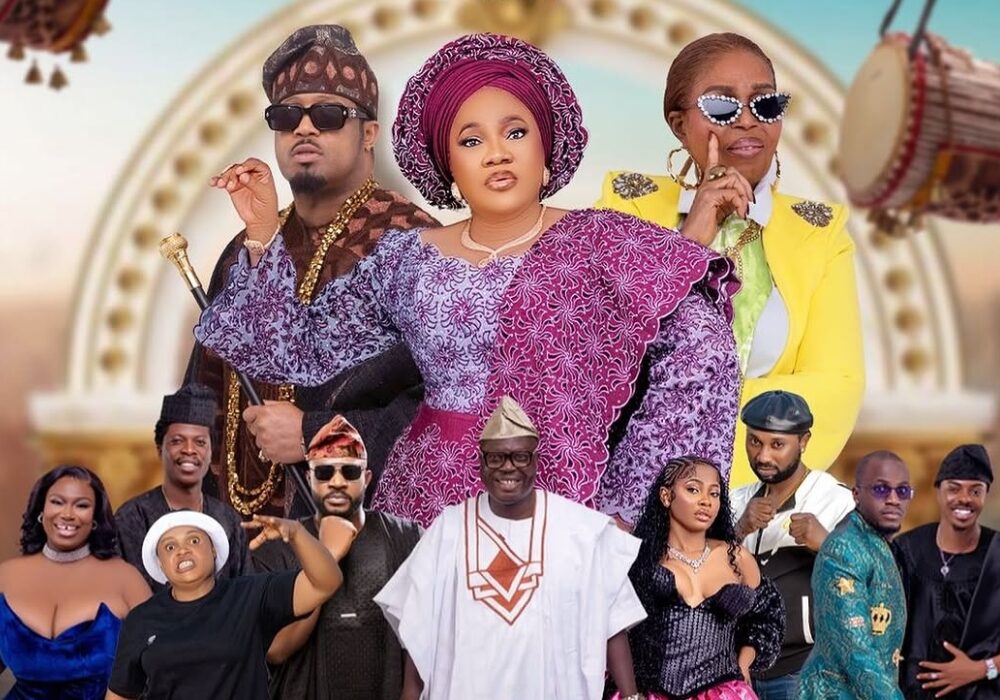
The typical Toyin Abraham flick has a number of easily identifiable features: loudness, crassness, loud crassness, incoherence, and a slapdash approach to storytelling. Somehow, she has made enough commercially successful movies in this mould to become one of Nigeria’s main box office draws. Each film she makes is a box office event, a trend that new picture, Oversabi Aunty, continues. But this time, there’s a slight departure from her previous work. How so? Well, Oversabi Aunty is the most coherent and cohesive work Toyin Abraham has sent out to the cinemas. This is somewhat impressive—within her oeuvre as producer—because the film marks Abraham’s debut as a director.
Centred around a family led by an Igbo father (Michael Ezuruonye) and a Yoruba mother (Abraham herself), the film deals with themes of tribalism, religious zealotry, generational differences, and, ultimately, familial sacrifice. As you can imagine, none of themes are treated to satisfaction when the film comes to a conclusion—yet, compared to her previous work, the batshit Yoruba epic Iyalode, the new film is pretty sane. There are very few digressions in the film’s chronicling of the fall of an outwardly righteous Nigerian family.
Abraham’s character, Toun, the family’s matriarch, is a church worker quite happy to tell others how to behave and comport themselves in public, using her own kids as examples. She’s happy to shove breasts deeper into their owner’s revealing outfits and shove those who err out of the church. At home, she and her husband are engaged in a Yoruba vs Igbo fight that is overplayed for comedic value. Are their fights serious? Who knows? It just happens to be the kind of situation that Abraham has wrung some hilarity out of over the years. She does so again here, proving she is, by herself, the main dish in her cinematic servings.
Telling a coherent story is a low bar Toyin Abraham has finally managed to clear with Oversabi Aunty.
Efiko Score: 5.1
In Oversabi Aunty, she gets some assistance in this department from Queen Nwokoye, who plays Toun’s sister-in-law, a rude woman with kids from several men. In one of the film’s funny scenes, her demand for cash from her brother is domestic terrorism. That Abraham and Nwokoye do not have a scene where they do battle comes to feel like a disservice to fans of the kind of noisily brash comedy that is the hallmark of Nollywood comedies of this sort.
Somehow despite Toun’s zeal, her kids have chosen a different path. While the eldest (Efe Irele) is about to get wedded seemingly without considering chasteness a prerequisite, one of the younger siblings has a need to advertise her sex appeal online and in clubs; another leads quite the double life; and the sole male sibling (Eniola Adeoluwa) has an anger problem. The film doesn’t tell us how a zealous woman raised kids of this nature but this is normal. Character in mainstream Nollywood comedy is deterministic. Abraham’s films aren’t interested in asking why, only in consequences that can be plumbed for humour—and, in the specific case of Oversabi Aunty, a late moral comeuppance.
When that comeuppance does arrive, it is too quick and too heavy for a film that is mostly light. It also seems to defy legal logic. The only reason it works in its own wonky way is that this is a Toyin Abraham film—and one that manages to stick to the main story it tells. This, of course, is a low bar to scale for a certain type of filmmaker. For Abraham, though, scaling that low bar, is Olympian. You only need to see her previous work to understand why.
Oversabi Aunty is showing across cinemas in Nigeria