There’s a reason Fela Kuti has remained relevant, decades after his passing in 1997. His music is too infectious, his songwriting too strong, and his stage performances too erotically charged.
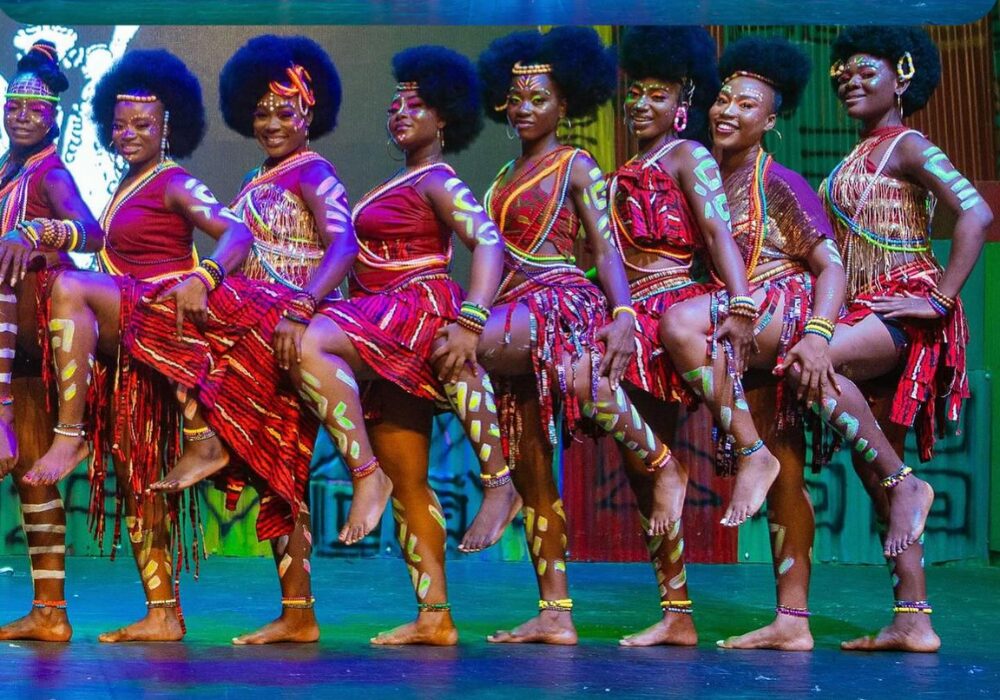
The theatre and film director-producer Bolanle Austen-Peters seems aware of these qualities—enough that she deploys the relentless vigour of Fela’s music and style to bolster her own brilliant use of space, symmetry, and the body in this version of her most successful play, Fela And the Kalakuta Queens. She may also be aware to understand that the play’s weak writing and plotting can be ignored in the presence of Fela’s musical genius.
What story there is really begins when Malaika, a lady who shows up, ostensibly seeking to study Fela, becomes enamoured of the maestro, turning the long-term women of the Fela household into canisters of jealousy. The relationship between these women and its fallout form the story’s main thread. Subplots emerge but they’re hardly treated seriously or satisfactorily.
These plots, if we can even call them that, are largely chapters from Fela and his women’s actual biographies wrapped around his popular songs but because they’re sloppily written, their only use is providing some distraction before the play dispenses another Fela hit. It becomes quite obvious that too little thought was given to how certain songs fit the story told. For instance, the narrative around “Lady” hardly works. The one for “Zombie” is tenuous.
Feminist reading?
There is, of course, a feminist reclaiming of the women of Fela at play here. The women, after all, occupy somewhat equal billing with Fela in the title. But the weak playwriting prevents that from ever coming through strongly. Maybe the feminist angle works if the writing is strong as the music; it just isn’t. It’s not even close. Fela’s music is the strongest part of the play. How could it not be? In the near-three decades since his passing, Nigerian music isn’t over him.
Also, Fela is sui generis enough that it hardly seems possible that any entity in the real Kalakuta Republic—man, woman, or dog—could ever be on equal footing, titular prominence be damned. Which is one reason the play’s producers deserve plaudits for finding an excellent Fela.
As Fela, ‘Laitan Adeniji, jazz player in his other life, commands the stage, his timbre, stature, and aura all forcing the case. He wears the late Kuti’s mannerism and peculiar outfits with aplomb. Is Adeniji our greatest Fela, a man with many copycats, even within his family? Well, he has my vote.
Staging sex appeal
His Queens are just as good. As with the Fela dancers of old, these Kalakuta Queens secrete a frenetic sexiness onstage. And the script puts a few sassy words in their mouth. In one scene, a record exec says, “This is a private property.” Comes the reply: “We don public am”. The delivery of that noun-verb flip is something.
But the exceptional cast members can’t save the play’s latter half as the vigour with which the story begins ebbs. As it is with Austen-Peters’ film projects, the culprit is the writing: it’s much too weak to support the show’s lengthy runtime and the songs don’t show up frequently enough to distract the viewer from the malfunctioning narrative engine.
Thankfully, there’s an intermission that leads directly into a barnstorming performance of yet another Fela hit. So that, by the end, you may have forgotten the play’s flimsy, jumbled story. But the play’s interpretation of “Palaver”, “Shakara”, and “Water No Get Enemy” might be imprinted on your brain.
Austen-Peters doesn’t have the writing chops to match Fela’s artistry. But she does have mastery of her Terra Kulture stage, using it to dazzling sound-and-light effect, even when almost 2 dozen persons are on. So, while Fela and the Kalakuta Queens fails to match the great man with a great story of his women, it somehow works because its filled with spectacle—and an abundance of glorious Afrobeat music.