You have to admire the non-mainstream Nigerian filmmaker who sticks to his guns. By that I mean you have to admire Damilola Orimogunje, the filmmaker who has now produced three feature films—two as director—with a slow-burn intensity atypical of the industry he works in. That admiration is two-fold: you admire his commitment to an unconventional style and, after seeing Dear Ajayi, his latest, you admire how he’s honed his tool, his sensibility, to deliver an accomplished slice of Nigerian life drama. It is one thing to want to create art-house cinema; it’s another thing entirely to do so as capably as he has done with his latest, for which, months ago, he became the first Nigerian filmmaker to appear in Venice with a feature.
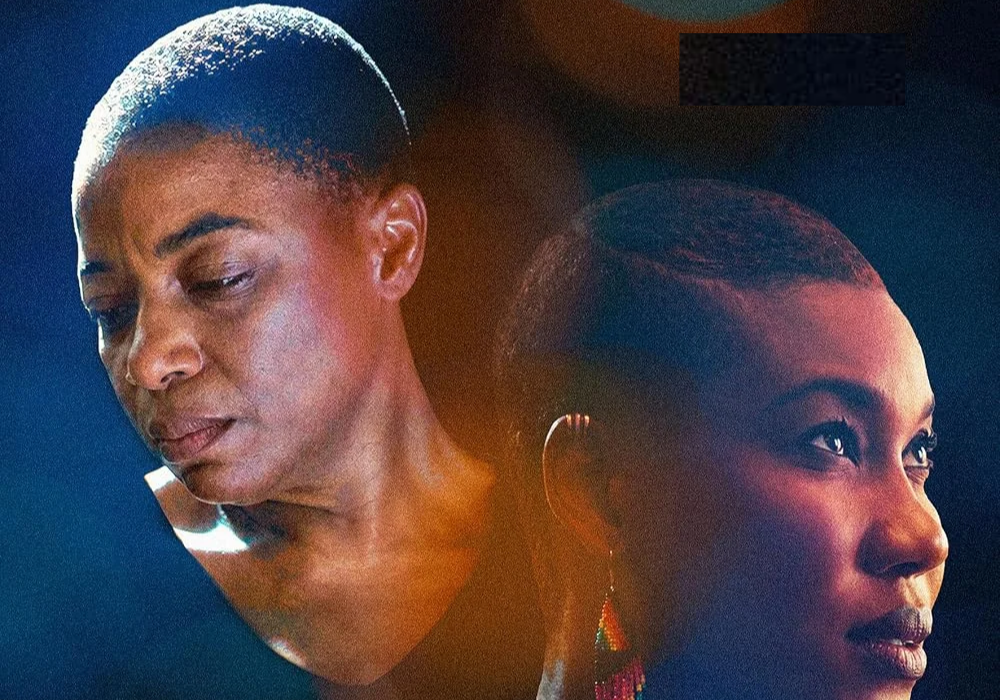
Set in 1990s’ Nigeria, the film follows Ade and Titi, two sisters living in southwest Nigeria. They care for their ailing mother while each navigates the vagaries of an essentially deprived life. Ade, as played by Bimbo Akintola, is the elder sister; she works as a nurse and has two kids she raises with her husband, a down-on-his-luck visual artist. Titi, Tosin Adeyemi, is a singer doing what young people do: hanging out with friends, drinking at bars, and, according to her elder sister, being self-absorbed. The point is made early: these are sisters; they are not buddies.
The household is pretty much kept together by Ade, and she does her best to not let the strain show, even when her husband blames her for not kicking his ass to go out there and hustle out a living. It’s a tricky manoeuvre: the screenplay, also by Orimogunje, tries to not fall into the trap of all-men-are-evil but this is clearly a story sympathising with the fate of the Nigerian woman. The main reason Dear Ajayi succeeds in achieving a level of neutrality is its subtlety. Nothing in the film is hurried. The characters speak calmly mostly, the camera moves leisurely, time goes by unhurriedly.
What this means as the story unfolds over years is that there is the question of pacing—the Nigerian arthouse director’s traditional problem. How do you make a slow-burn project about Nigerian characters—with the right weight, without the tedium? Orimogunje answers the question brilliantly. Somehow, he has gauged the right amount of time to spend on a scene, for which editor Olalekan Afolabi also deserves credit. Perhaps his major trick is to set the film mostly away from Lagos, the frenzied capital of Nigeria and Nollywood. By setting his story in a somewhat pastoral idyll away from the city, he has chosen the right setting and atmosphere for a story with a more subtle approach to suspense. Plot is not the attraction here; character is.
And that’s probably why the one question that’s likely to follow the film is this: Why should we care? I don’t believe there’s an intrinsic reason to care about these women and their men. The only reason is that the film’s writer-director cares about them and in telling us about them with the kind of delicacy he deploys, he convinces us, too, to care. That’s unlikely to change the mind of viewers not quite used to the slower kind of arthouse films—in which case, it should help to think of these women as symbolic entities, carrying in their bodies, gestures, and actions, the stories of a certain type of longsuffering Nigerian woman common in 1990s’ Nigeria than today. The model here is a particular type of European and Asian film not mainstream Nollywood.
Dear Ajayi isn’t the first Nigerian film to work in this mode. The Esiri brothers’ Eyimofe is perhaps the most celebrated project in this style. But that film’s characters were aspiring for better in a way that one might associate with Lagos residents. This film’s leads are more content; they have their own desires but that desire is of the domestic sort. The one character here that’s really hungry for the citified version of success manages to succeed but in doing so, destroys something essential about the life of the unit he inhabits.
And, somehow, the consequences of that success lead to what strikes me as Dear Ajayi’s one capitulation to a specific visual and narrative cliché common in arthouse circles. It comes right at the end when Ade, having been freed from the forces one might say are holding her down, smiles at the camera as she moves towards it in slow motion, a familiar move in films of this sort. Narratively, the idea obviously is she has her freedom and freedom at any cost is fine—and yet, I couldn’t help thinking that whatever that joy is, it is pyrrhic. That shouldn’t be joy on her face, unless the screenplay has designed it to be so, so that, by the end of the film, the sisters are in different places, as they were at the start. It’s symmetrical in a narrative sense; it just doesn’t come across as earned, especially not for a Nigerian woman with kids before the 2010s.
As for performances, this is a film where the cast members are evenly matched. Adeyemi and Akintola are fine, as are supporting actors Uzoamaka Power and Tope Tedela. But it is the film’s older cast members that truly excel. Antar Laniyan, who hasn’t been seen in mainstream circles in years, is superb as an older man who falls for and marries Titi. And Lanre Hassan is immense as Ade and Titi’s ailing mother so much so that she deserves a Best Supporting Actress nod at major awards even as she does nothing but groan in her limited screentime.
Much will be made of KC Obiajulu’s gorgeous cinematography and Abisola Omolade’s picturesque art direction, and deservedly so. But all of that fine work won’t amount to much without the sensibility of a homegrown director stubbornly crafting an interesting path in contemporary Nigerian cinema.